It had always been clear to me that once I turned 18 I wanted to get my driving licence as fast as possible. On the way to the licence, the Nothelferkurs (first-aid course) is the step you have to get through. And getting through it was, honestly, all I had in mind. So after a quick Google search I signed up for a Nothelferkurs on the next available date. Giving up a free weekend for two course days was a bit of a chore and, frankly, painful. But I had set myself an ambitious goal with the licence. So I just had to get on with it.
Saturday morning it started at 9:00. I was a little early. The course room was inside a fairly large driving school. About 10 participants had turned up. Nobody knew anybody. Only a shy «hello» went round. But one thing was quite clear: we were all roughly the same age and had the same goal, to set off on the road to a driving licence. After one participant made a dry joke, the mood loosened up quickly.
The instructor came in. She was young and open, and picked up straight away on the joke she had probably overheard in the corridor. It slowly dawned on me: the weekend is not going to be as bad as I first thought. Luckily. After a short round of introductions, the Nothelferkurs was already under way. The theory part came first. The instructor had opened her PowerPoint and began to introduce the topics that would keep us company all weekend:
In summary:
- how to assess an emergency situation correctly
- what to do at an accident: rescuing, securing the scene, raising the alarm properly
- how to give first aid as well as possible
- stopping bleeding and applying a pressure bandage
- checking consciousness, positioning an unconscious person
- life-saving immediate measures
- chest compressions with rescue breaths
- treating burns
- how to use a defibrillator correctly
The theory part was relaxed. Again and again the instructor was able to bring the theory closer to us with real examples she had experienced herself. That was very interesting and at times a little frightening too. What was pleasant was that she did not just stand at the front dryly narrating her PowerPoint. No, it was much more of an easy-going conversation in which everyone could bring in their own experiences. I found it especially interesting that a trainee nurse was there who could link a lot of it directly to her job. Now and then a short video was shown for variety. The time went by very fast and, after a couple of short breaks, it was already time for lunch. The mood among us had loosened up, so we all decided to go together to the snack bar next door.
After lunch it carried on. In the theory part that morning we had learned how and where emergency situations can arise and how to react on the spot. Incidentally, it is very likely that anyone who takes part in road traffic will be confronted with such an emergency, one where you have to act correctly very fast. That is why it is so important to be able to assess the situation properly and to react correctly without thinking too long and without panic. It can decide between life and death in a fraction of a second. These sequences and movements have to become second nature.
In the afternoon we tried to deepen exactly that with practical role plays. The focus was on the memory aid GABI (it stands for: G: Gibt er Antwort? A: Antwortet er? B: Beantwortet er meine Frage? I: Ist er im Stande zu antworten? – four ways of asking whether the person responds) for assessing the situation. The next step covered the correct sequence for making an emergency call and for securing the accident site. Luckily there were a few volunteers who threw themselves into the role plays with great enthusiasm. The onlookers discussed it together and offered suggestions for improvement. And then the first day was already over.
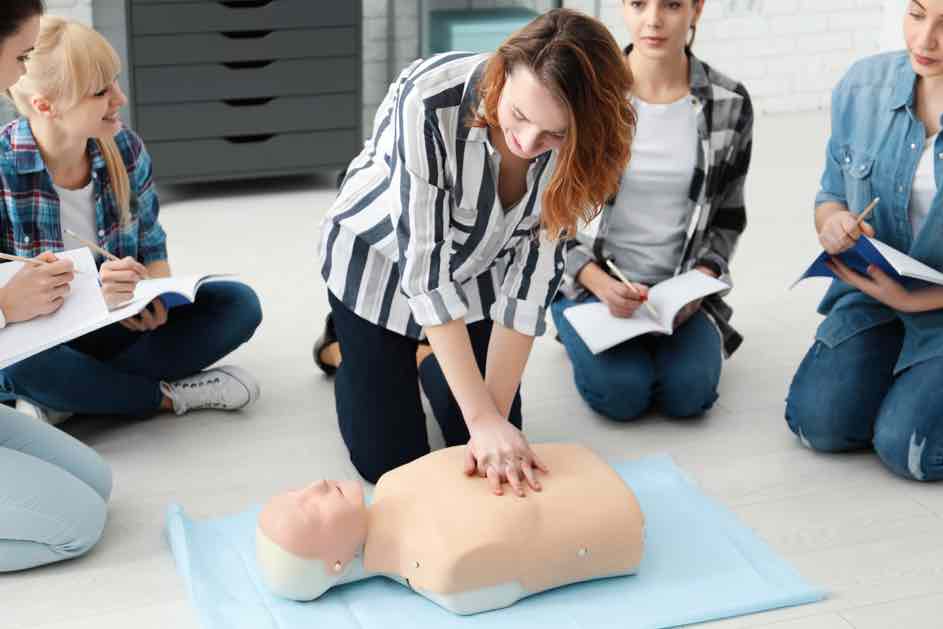
The next day started again at 9:00. First we turned to another block of theory. This time it was about measures to help accident victims. We were shown how devastating it can be if, for example, a casualty is positioned wrongly. In the afternoon, again after a shared lunch, we carried on with the practical part. We tried rescue breathing and chest compressions on dummies. In an accident it is not only cuts and broken bones that occur, but also scalds, burns and crush injuries. You have to be able to deal with wound care, and if necessary even know how to use a defibrillator. You should also make sure that other people are not wandering aimlessly around the accident site or even taking photos and videos. It is extremely important that everyone takes a sensible part in the first-aid measures until the ambulance arrives with the rescue crew.
And then the whole thing was already over. We had completed the Nothelferkurs successfully and could concentrate on the next steps towards the driving licence. Like a lot of people, I did the Nothelferkurs because it is simply compulsory, but in the end I have to say: it was fun, because of the good group, because of the motivated and easy-going instructor, but above all because of the genuinely important content. Knowing these sequences and movements can be decisive, and they matter not only for driving but for any other emergency too.
How do I have to prepare for the Nothelferkurs?
Since the Nothelferkurs does not include a test and only has to be completed and attended, no preparation is necessary. But you are welcome to test your knowledge at this link at SRF and also at Watson. The test takes 2 minutes and gives you a taste of the content covered in the Nothelferkurs.
And this documentary by NDR shows what matters in first aid!