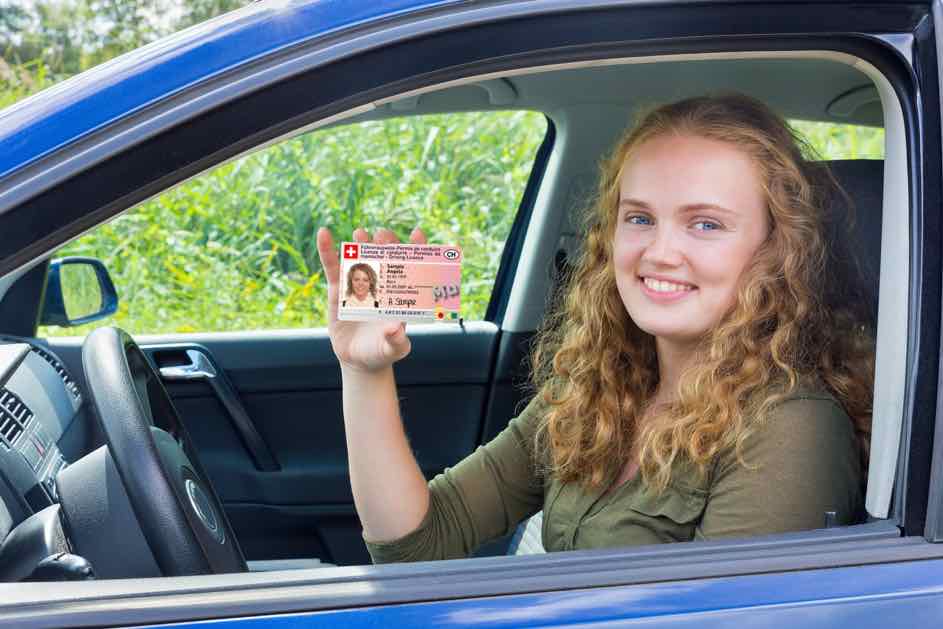
There is a lot to know about the Swiss car driving licence, especially when you are about to take it yourself and are coming across the subject for the first time. How high are the costs? What is the minimum age? Which cars am I actually allowed to drive?
This article gives you an overview of the Swiss driving licence and of the road you have to travel to get one.
01
Driving licence costs in Switzerland
A category B driving licence in Switzerland costs between 2`660 francs (automatic) and 3`560 francs (manual). That is a lot of money, especially for young people, who make up the largest share of new drivers. You should be aware that this amount is not due all at once, but spread over a longer period (between 6 and 24 months). The detailed breakdown in the following table will give you a clearer picture.
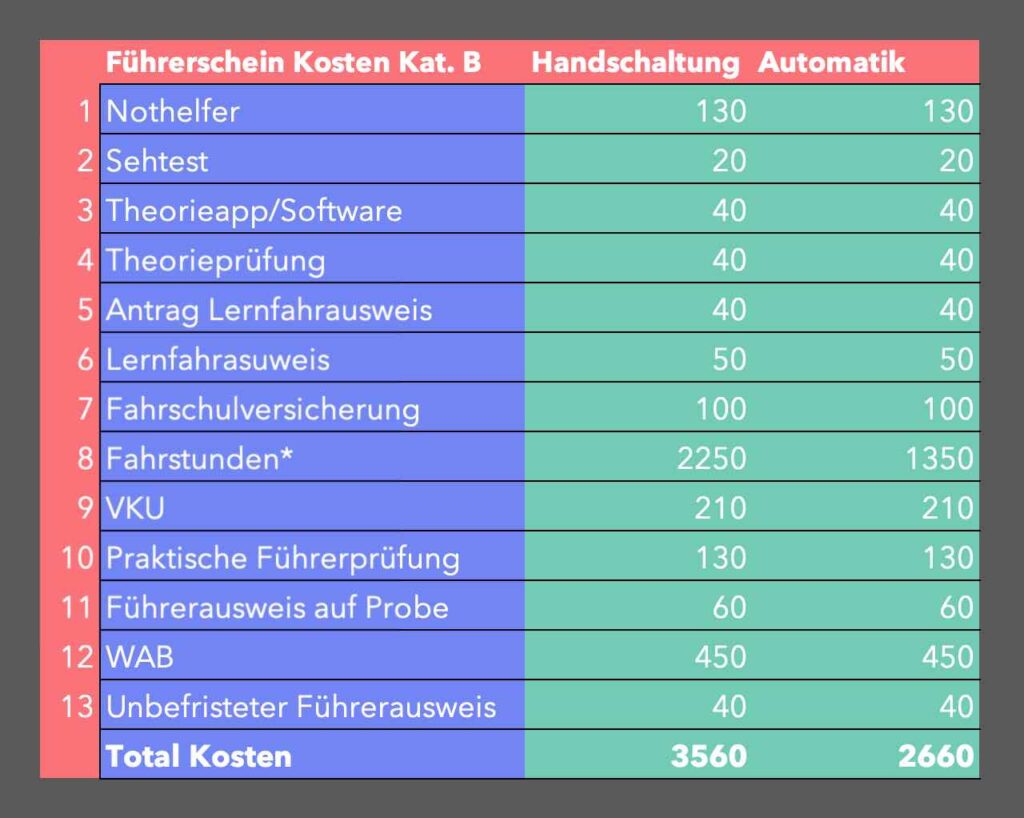
These costs are Swiss averages and can differ a great deal not only from canton to canton, but also from learner to learner. That is a lot of money, especially for young people, who make up the largest share of new drivers. You should be aware that this amount is not due all at once, but spread over a longer period (between 6 and 24 months). In the following table we have set out the monthly costs, depending on how long you take to get your licence and on whether you learn with an automatic or a manual gearbox:
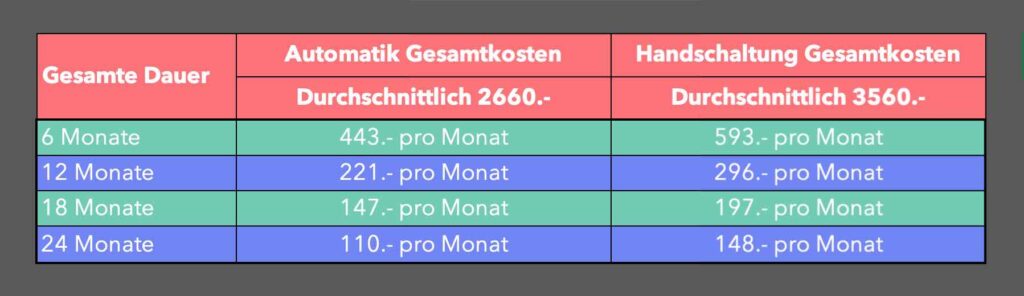
As you can easily see, there are big differences in when costs arise and how large they are.
You will find a more detailed cost overview for the driving licence in the article «Cost overview driving licence»
For a picture of your own situation, see our cost overview for the driving licence.
You can also get further information from the Strassenverkehrsamt (cantonal road traffic office) of the canton you live in.
02
Driving licence in Switzerland at 17
Starting the road to your driving licence at 17 is allowed in Switzerland. From your 17th birthday you can apply for the Lernfahrausweis (learner’s permit), followed by a compulsory learning phase of 12 months, after which you can take the practical driving test. This newer rule applies to everyone who applies for the learner’s permit before the tender age of 20. If you are older, you no longer have to do a learning phase.
What else you need to know about «a driving licence at 17», and which special rule applies to everyone born in 2005, is explained in the article „Driving licence at 17“.
03
Lernfahrausweis Switzerland
Before you can apply for the Lernfahrausweis (learner’s permit) in Switzerland, you have to have completed the Nothelferkurs (first-aid course) and the eyesight test. You also have to be at least 17 years old. Next you go to the Strassenverkehrsamt (cantonal road traffic office) of the canton you live in and hand everything in, with the completed form and the passport photos enclosed. After a certain amount of administrative processing you receive a number with which you can register for the theory test. Once you have passed it, your Lernfahrausweis is sent to you. Here is what you need to know about the Swiss learner’s permit:
- The learner’s permit is valid for 2 years and cannot be extended
- Whenever you are behind the wheel, the car must be clearly marked with the «blue L».
- You may only drive with an accompanying person. Your passenger must be at least 23 years old, have held the licence for the relevant category for 3 years and hold the final, non-probationary licence.
- With the learner’s permit you can take driving lessons with a driving instructor.
- You first have to complete the 12-month learning phase and take the VKU before you can register for the practical driving test.
04
Swiss driving licence: period of validity / expiry date
How long are the various driving authorisations actually valid in Switzerland? Plenty of people have certainly wondered. Here is the answer:
- The learner’s permit is valid for 2 years.
- The probationary licence is valid for 3 years.
- The International Driving Permit is valid for 3 years. But the International Driving Permit is only valid in combination with the Swiss licence. So you always have to carry both.
You will find more information about the International Driving Permit here.
05
Category B driving licence
When people talk about a category B driving licence, they mean the ordinary licence that most people in Switzerland hold. This is the driving authorisation that, in everyday language, lets you drive a car. But which vehicles exactly may you drive with a category B licence? Good question, here is the answer:
- You may drive cars and three-wheeled motor vehicles with a total weight of no more than 3500 kg and no more than eight seats. The driver’s seat is not counted.
- You may drive a combination of a category B towing vehicle and a trailer. The trailer must not exceed a total weight of 750kg.
- You may drive a combination of a category B towing vehicle and a trailer with a total weight of more than 750kg. But the combined weight (car + trailer) must not exceed 3500kg.
You will find more information about the driving licence categories here.
06
Abroad on a probationary licence
The probationary licence is valid abroad as well. But if you want to drive further afield than Europe, there are, in rare cases, certain special rules. Ask the relevant embassy or consulate.
07
Applying for the Lernfahrausweis
Step 1: Nothelferkurs (first-aid course)
The first thing you have to do is the Nothelferkurs. After completing the course, which lasts 10 hours in total, you receive the Nothelferausweis (first-aid certificate). It is valid for 6 years.
You will find more information in the article „Nothelferkurs“.
Step 2: Eyesight test
You can take the eyesight test at any recognised optician or eye doctor.
You will find more information in the article „Eyesight test“.
Step 3: Applying for the Lernfahrausweis
With the completed application form for the learner’s permit (including the eyesight test), the first-aid certificate, colour passport photos and a valid identity document (ID card, passport or residence permit), you go to the Strassenverkehrsamt (cantonal road traffic office) of the canton you live in, or to the residents’ registration office of your municipality, and hand the documents in. Your application is checked and you receive a reference number with which you can register for the theory test.
You will find more information in the article „Applying for the Lernfahrausweis“.
Step 4: Theory test
With the reference number you can register for the theory test. How you register differs from canton to canton.
You will find more information in the article „Theory test“.
Step 5: Lernfahrausweis
Once you have passed the theory test, your learner’s permit is sent to you by post.
You will find more information about the learner’s permit in the article „Lernfahrausweis“.
08
The probationary licence in Switzerland
In Switzerland you receive the Führerausweis auf Probe (probationary licence) once you have passed the practical driving test. This time-limited driving authorisation is valid for 3 years. In the first 12 months of this Probezeit (probationary period) you have to take the WAB-Kurs (compulsory further-training course). The probationary licence counts as a full driving licence, but offences and breaches of the road traffic act are punished more strictly.
You will find more information in the article „Probationary licence“.
You can pick up useful tips on how best to behave during this probationary period in this video.
09
Exchanging a foreign driving licence
Anyone moving to Switzerland has to exchange their foreign driving licence at the Strassenverkehrsamt (cantonal road traffic office) of their canton of residence within twelve months of taking up residence. Licences from EU and EFTA states are exchanged without a test; for licences from most other states the office requires a Kontrollfahrt (assessment drive), but no theory test. Bring: the application form, the foreign licence, your passport or ID card with your residence permit, and an eyesight test. Once the twelve months are up, you may no longer drive in Switzerland until the exchange has been completed. The addresses of all the road traffic offices are listed under Lernfahrausweis beantragen.