WAB course Switzerland: who, by when, cost, providers
The further training course after the driving test: who has to do it, by when, what it costs, what it covers and where to find a…
ReadSigns · Parking
Halteverbot means: do not even stop. Parkverbot means: stopping yes, leaving the car no — for as long as somebody gets in or out or you unload something. Both signs are blue with a red border; the no-stopping sign carries two red bars, the no-parking sign one. In the ordinance they are called «Halten verboten» (2.49) and «Parkieren verboten» (2.50), and they mean the same thing everywhere in Switzerland. Then there are the yellow markings at the kerb, which say the same without a sign, and the court-ordered parking ban that a judge grants for a single property.
The difference in one picture
A way to remember it: two bars cross out everything, one bar only the parking. Both signs look the way annex 2 of the SSV lays them down (art. 2 para. 1bis SSV). Both apply on the side of the road they stand on, until the end plate (5.06) and at most to the end of the next junction (art. 16 para. 2 SSV and art. 30 para. 3 SSV).
The question you came with
Two things decide it: what stands at the kerb, and what you are doing. Pick both and you get the answer with the article it comes from.
Without JavaScript this card shows the commonest case only. The same cases are answered in words in the five questions below.
Answered directly
As of September 2026. Sources: the Signalisationsverordnung (SSV) art. 30 and the Verkehrsregelnverordnung (VRV) art. 18, 19 and 41, both in the version of 1 July 2026, read on fedlex. There is no official English version of either — the German wording binds. Signs and markings are part of the subject matter of the basic theory test (art. 13 para. 1 VZV and annex 11 no. II.1.1 VZV). Parking itself is marked later on, in the practical driving test.
Yes. Parking is leaving the vehicle for something other than letting people in or out or loading goods (art. 19 para. 1 VRV). Letting somebody out is stopping, and stopping is allowed where parking is prohibited — for as long as it takes, and not a minute longer.
No. The sign «Halten verboten» forbids every voluntary stop (art. 30 para. 1 SSV) — whether somebody sits in the car makes no difference. Only the halt that traffic forces on you stays allowed: at the lights, in a queue, at a pedestrian crossing.
As long as the unloading actually takes — the ordinance names no fixed number of minutes. Whoever unloads the goods and then goes into the shop is parking. And stopping to load beside parked cars is allowed only when traffic is not obstructed (art. 18 para. 4 VRV).
Yes. Where the sign «Halten verboten» stands at the kerb, it covers the adjoining pavement as well (art. 30 para. 2 SSV). And parking on a pavement is forbidden anyway unless a sign or a marking expressly allows it; without one you may only stop there to load or to let people in and out, at least 1.50 metres must stay free for pedestrians at all times, and you have to finish without delay (art. 41 para. 1bis VRV).
On main roads outside built-up areas, on main roads inside them where two cars could then no longer pass each other, within 20 metres of level crossings, on bridges, in front of driveways to other people’s buildings or land, and on cycle lanes as well as on the carriageway beside them (art. 19 para. 2 VRV) — and everywhere stopping is prohibited: at places without a clear view, in narrow sections, on junctions and within 5 metres before and after the crossing carriageway, on a pedestrian crossing and right beside one (and, where no no-stopping line is painted, within 5 metres before it), on level crossings and in underpasses, in front of signs that would be hidden (art. 18 para. 2 VRV).
The word everything hangs on
The ordinance needs a single sentence for it: parking is leaving the vehicle for something other than letting people in or out or loading goods (art. 19 para. 1 VRV). Everything else is stopping. Whether the engine runs, whether somebody sits in the car, whether it is two minutes — none of that decides. What decides is the purpose.
From that follows the difference between the two signs. No parking takes only the leaving away from you; whoever unloads or picks somebody up may stand for as long as it takes. No stopping takes that away too: every voluntary halt is forbidden (art. 30 para. 1 SSV). Only the halt traffic forces on you stays allowed — the queue, the lights, the pedestrian on the crossing.
And without a sign? Then the lists in the VRV apply: art. 18 says where stopping is forbidden, art. 19 where parking is forbidden on top of that. The five questions above sum them up. Two of the figures work differently and are worth keeping apart: the 5 metres before a pedestrian crossing are a no-stopping rule and apply only where no no-stopping line is painted (art. 18 para. 2 let. e VRV); the 20 metres at a level crossing are a no-parking rule and apply always (art. 19 para. 2 let. e VRV).
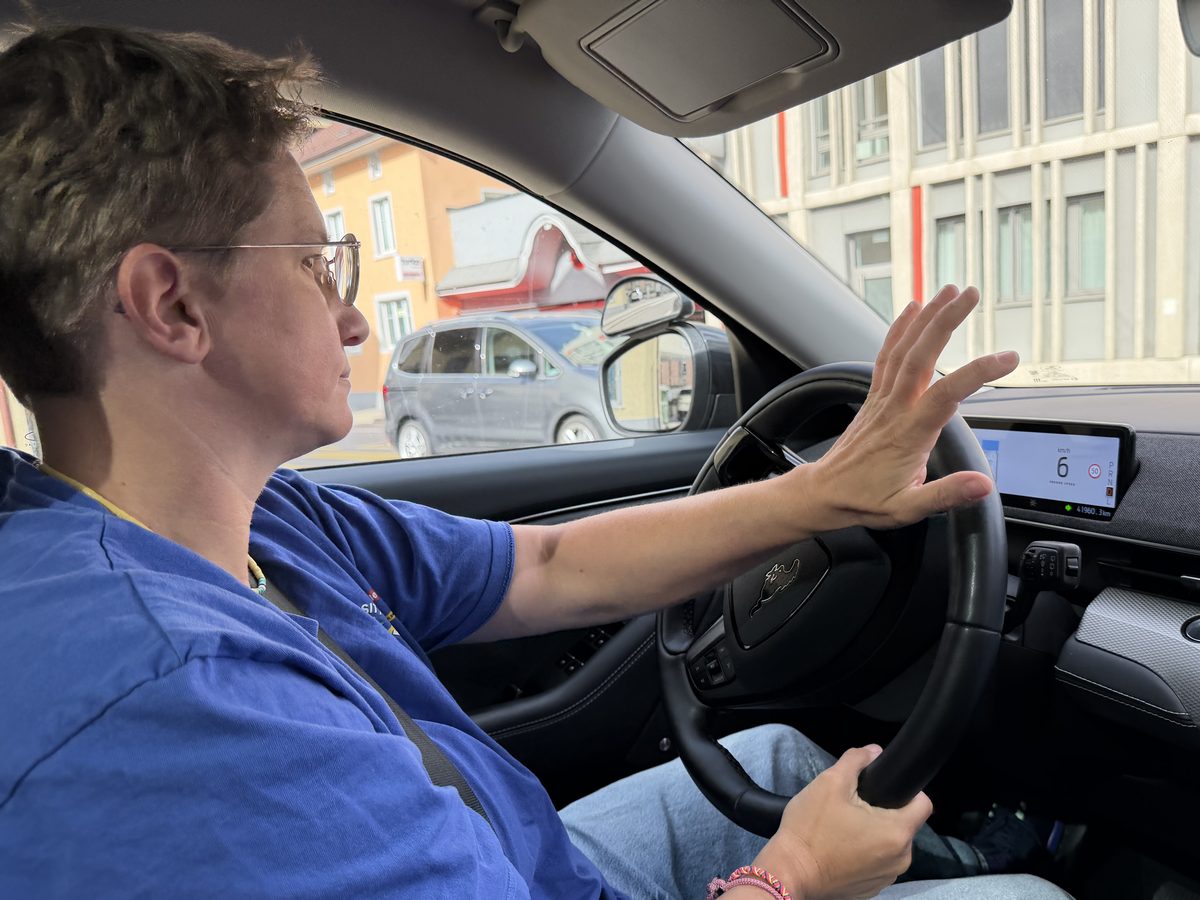
Try it
Yes. Letting people in and out is stopping, not parking — for as long as it takes.
Move the slider as far as you like: the answer does not change. The ordinance names no number of minutes at all — it asks what the stop is for (art. 19 para. 1 VRV).
The signs
Both signs stand at the right-hand edge and apply to that side of the road. How far they reach is told by the plates underneath: the start plate, the end plate, the direction plate — and the times at which the prohibition does not apply. At the end come the two signs that say the opposite: parking permitted, and the blue zone with a parking disc — how long you may stand there and which time the disc should show is on the blue zone and the parking disc.
How far does it reach?
The prohibition applies from the sign to the end plate, and at the latest to the end of the next junction. art. 16 para. 2 SSV, art. 30 para. 3 SSV
The no-parking zone. The zone sign — a white panel with the word ZONE and the no-parking sign inside it — applies to a whole neighbourhood until the end-of-zone sign, not only to the next junction (art. 2a para. 3 SSV); such a zone is allowed inside built-up areas only (art. 2a para. 2 SSV). Inside the zone parking is prohibited, and wherever parking bays are marked you may park only within those bays (art. 79 para. 6 SSV).
The plate «Parkieren verboten» without a sign. A white plate with those words on a wall or a driveway is not a sign of the ordinance. On private ground it is the owner’s wish — it becomes enforceable only with the court-ordered ban the next section explains. Parking in front of somebody else’s driveway is prohibited in any case (art. 19 para. 2 let. g VRV), with no plate at all.
The private ban with a fine
Whoever holds a right in rem over a piece of land — usually its owner — can ask the court to order that any disturbance of possession be stopped, parking on the forecourt included. The law calls it a judicial prohibition (art. 258 ZPO); on the plate and in everyday speech it is the richterliches Parkverbot. It has to be published and displayed visibly on the property (art. 259 ZPO), which is why you see the plate with the court reference at driveways and car parks.
Why it is dearer: a breach is punished on application with a fine of up to CHF 2,000 (art. 258 para. 1 ZPO). That is not a fixed penalty from the schedule of fines but criminal proceedings that the entitled person can set in motion. Whoever will not accept the prohibition has to object to the court within 30 days of its publication and of the plate going up on the property (art. 260 ZPO); after that it stands.
The core in one sentence: the official parking ban comes from the authorities and sits on the blue-and-red sign; the court-ordered one comes from a judge for a single property and has to be displayed visibly on it (art. 259 ZPO) — and both are meant seriously.
No sign, on the ground
Yellow at the kerb means: do not park here — and, depending on the shape, do not stop either. A continuous yellow line is a no-stopping line, a yellow line broken by crosses a no-parking line, and a yellow box with a diagonal cross a no-parking box (art. 79a paras. 1 and 2 SSV). It only becomes a reserved space once it carries an inscription such as «Taxi» or a symbol. Yellow zigzag lines are something else: they mark public transport stops, where you may stop only to let people in and out (art. 79a para. 3 SSV).
What it costs
Parking where parking is prohibited, stopping where stopping is prohibited, standing on a pedestrian crossing or in front of a driveway — each of those is a fixed penalty under the federal schedule of fines (Ordnungsbussenverordnung, OBV, SR 314.11, annex 1), and each has its own amount: a no-stopping sign is item 230, a no-parking sign item 250, a pedestrian crossing item 214, somebody else’s driveway items 247 and 248. The figures themselves are in annex 1 of that ordinance and not here — an amount on a page that does not maintain it would be wrong after the next change. Our fines calculator (in German) works out speed, phone, seatbelt and red-light penalties, and two parking ones: overstaying the paid time, and parking on the pavement. What an offence triggers during the probation period is on the licence on probation.
Check yourself
Reading about a sign and recognising it at 50 km/h are two different things. The quiz asks the fourteen signs, plates and markings this page shows — in two rounds of seven, so each one comes up once.
We count, anonymously, which sign gets read wrongly most often — no address, no cookie, only the day and the answer. Below 500 rounds we publish no figure, and we are below it.
The ToDrive sign quiz
Every question shows one of the fourteen from this page. After each answer you see at once whether it was right, and what it means.
Next step
No stopping and no parking are two of the 184 signs and markings ToDrive shows on the main page, grouped, each with its meaning — and the ToDrive sign quiz, which shows you ten of them and says at once whether you know them. Both signs are exam material: how the theory test works explains how many questions you get and how many you may miss.
Related: how the theory test works, the most common mistakes in the test, what a fine triggers during probation.
Sources: Signalisationsverordnung (SSV, SR 741.21) art. 2, 2a, 16, 30, 48a, 64, 65, 77, 79, 79a and annex 2, and Verkehrsregelnverordnung (VRV, SR 741.11) art. 18, 19 and 41, both in the version of 1 July 2026; Zivilprozessordnung (ZPO, SR 272) art. 258–260 in the version of 1 July 2026; Ordnungsbussenverordnung (OBV, SR 314.11) annex 1 in the version of 1 August 2026; Verkehrszulassungsverordnung (VZV, SR 741.51) art. 13 and annex 11 no. II.1.1 in the version of 1 January 2026. All on fedlex, last checked on 21 September 2026.
Guides
The further training course after the driving test: who has to do it, by when, what it costs, what it covers and where to find a…
ReadZwölf Monate Frist, und die Kontrollfahrt hat nur einen Versuch. 31 Staaten sind ganz befreit, 14 weitere nur von der Kontrollfahrt.
ReadRead on